Driving Test Backlog: What Needs to Change?

July 31st, 2026

This article considers an independent report by Samuel Williams. Its research, conclusions and recommendations have not been produced by ADINJC or DVSA.
Introduction
The driving test backlog continues to affect learners and instructors across Great Britain.
Long waiting times make lesson planning more difficult, place added pressure on learners and leave many people unsure when they will be able to take their test.
Let’s weigh this up with a quick look at what jobs we have within our lessons and who does it best.
A new independent report, No Longer Temporary: The Driving Test Backlog and the Failure to Restore Examiner Capacity, asks whether recent measures have reduced the backlog or simply changed how a limited number of appointments are managed.
Using published DVSA data and building on the National Audit Office’s December 2025 investigation, it raises an important question: can waiting times fall without a lasting increase in examiner capacity?
Read the full independent report (Link)
Read the official DVSA response (Link)
Queue management is not capacity
The report’s central message is simple:
Queue management cannot substitute for capacity.
Booking changes can help appointments reach genuine learners and make the system harder to misuse. However, they do not create more tests.
According to the report, the January 2025 booking rule change was followed by an increase of around 51,700 forward bookings. The queue then continued to grow by approximately 4,900 bookings a month.
Forward bookings are appointments in the system, rather than a count of individual learners waiting for a test.
The report also examines the additional testing allowance introduced in June 2025. This funded around 116,000 tests outside examiners’ contracted hours at a cost of £3.7 million.
This does not mean that the money was wasted. Those appointments gave thousands of learners an opportunity to take their test.
However, the analysis found no detectable increase in the number of tests delivered per full-time equivalent examiner. The report’s point is that the allowance created additional activity, but not permanent capacity.
What happened when more examiners tested?
The clearest finding came from the temporary redeployment of qualified warrant card holders between October 2023 and March 2024.
The report found that this period was associated with around 868 additional tests a day, averaged across six months. When the redeployment ended, much of that increase was lost.
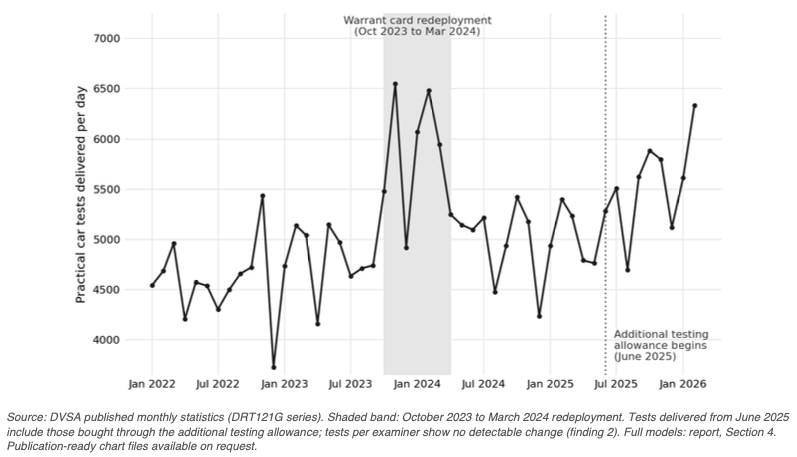
Source: DVSA published monthly statistics, DRT121G series. Analysis by Samuel Williams
The analysis identifies a statistical association. It does not claim that the intervention alone caused the change.
Even so, the finding supports a straightforward point. When more qualified examiners were available to conduct tests, more tests were delivered.
Temporary measures may help, but they cannot replace a stable and properly resourced workforce.
Progress and the route to recovery
The report recognises that progress has been made.
This includes examiner retention payments, expanded training capacity, the temporary use of Ministry of Defence examiners and the publication of more detailed test centre data.
However, it also highlights the scale of the recruitment challenge. Figures cited in the briefing show that 19 recruitment campaigns since February 2021 produced a net increase of 83 examiner full-time equivalents against an identified need for 400.
The briefing also notes that several recovery dates have been set, missed or withdrawn. DVSA’s business plan published in March did not provide a firm date for returning to the seven-week waiting time benchmark
What the report recommends
Samuel’s report makes four main recommendations:
- Restore workforce capacity: Publish a plan covering examiner recruitment, training, retention, safety and deployment.
- Measure access more accurately: Report how many examiners are actually available and consider demand that is not captured by existing bookings.
- Strengthen forecasting: Give the demand and waiting time model clear senior ownership.
- Publish recovery milestones: Explain what has changed and what happens next when progress slips.
These are the independent author’s recommendations, rather than formal ADINJC policy. However, the themes of workforce planning, transparency and accountability will be familiar to many across the profession.
What this means for ADIs
Driving instructors cannot solve a national capacity shortage, but they continue to manage its effects every day.
ADIs help learners remain motivated, maintain their skills and decide whether they are genuinely ready when a test becomes available.
As we explored in Making the Most of Driving Test Waiting Times, the delay does not have to become lost time. Learners can use it to experience unfamiliar roads, different weather conditions, night driving and heavier traffic.
That does not remove the need to improve the testing service.
Learners should be properly prepared before taking their test. They should also be able to access one within a reasonable period once they have reached the required standard.
Final Thoughts
Fairer booking rules matter. Additional tests matter. Better prepared learners matter.
But if waiting times are to fall and stay down, the service also needs enough qualified examiners to meet demand.
This independent report adds another perspective to the continuing discussion. Its findings should be considered alongside DVSA’s own evidence and future performance data.
What is clear is that short-term measures alone will not provide the certainty that learners and instructors need.
ADINJC will continue to monitor developments, engage with DVSA and represent members as work to improve the driving test service continues.
About the author
Samuel Williams, 24, is an unfunded, unaffiliated independent researcher based in Norfolk. He began this work after being unable to book a driving test himself. Available for interview at short notice.
07873 334020 (WhatsApp)
swpwilliams@protonmail.com



Categories
Recent Posts
Get In Touch
Create a free acccount or login
To continue reading this information, you need a free account that can be created in under a minute. Join today or login
Like to be kept informed?
Our free Lite membership delivers newsflashes and weekly roundups directly to your inbox, so you never miss a beat. Or become a Premium member to enjoy the wide-ranging support & benefits we offer.
Report
There was a problem reporting this post.
Block Member?
Please confirm you want to block this member.
You will no longer be able to:
- See blocked member's posts
- Mention this member in posts
Please allow a few minutes for this process to complete.
Share This: