

Every car has one. We make sure it works. Learners need to understand when and why they can use it. And yet, somewhere along the way, I think we’ve slightly forgotten what it’s actually for.
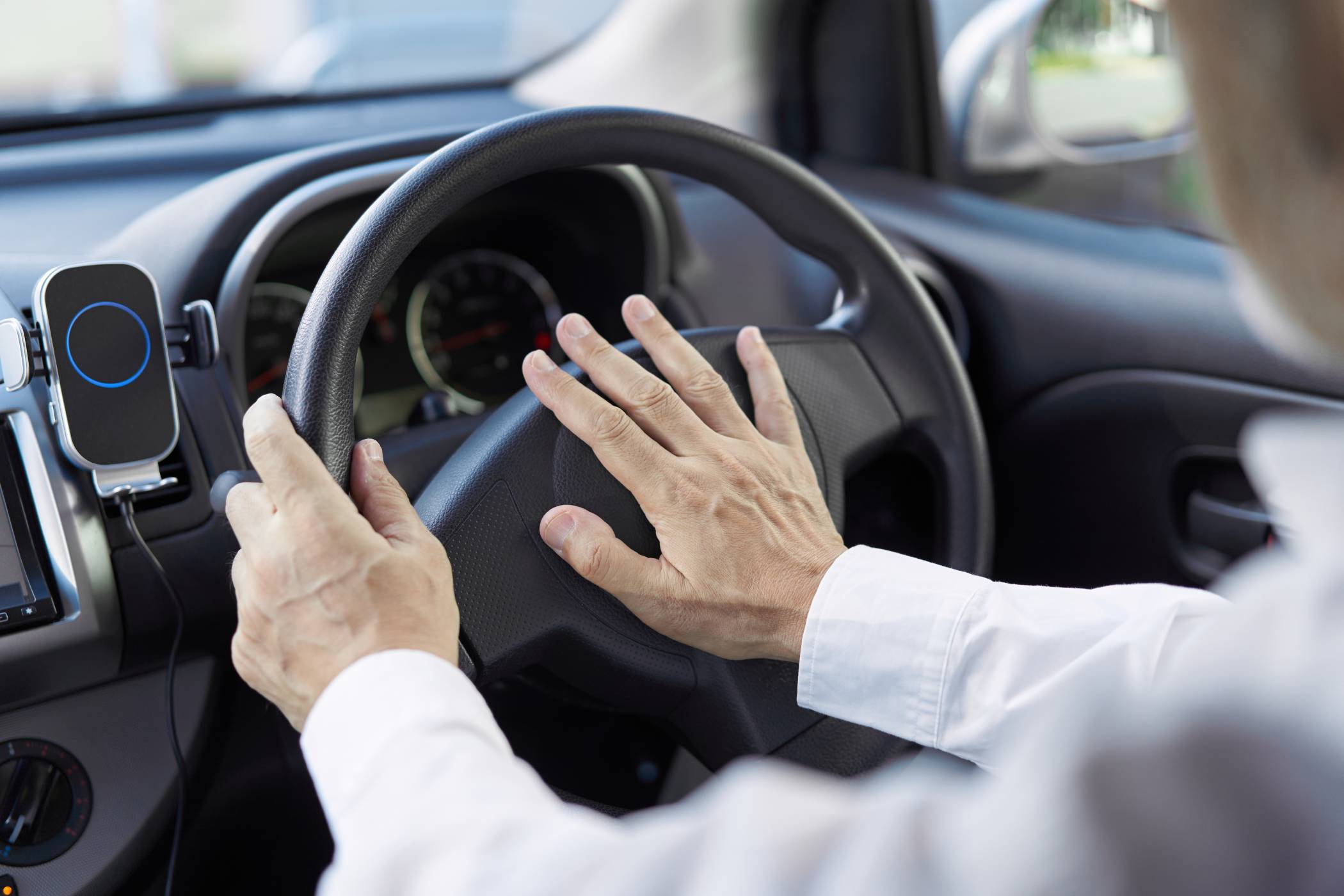
For many drivers, the horn has become less of a warning device and more of an anger button.
- Someone pulls out in front of us: HONK
- Someone hesitates slightly when the lights turn green: HONK
- Someone does something we don’t particularly like: HONK
But that isn’t really what it’s there for.
Let’s stop treating the horn as an expression of emotion and start treating it as a piece of safety equipment.
What is the horn actually for?
Rule 112 of the Highway Code is pretty clear. The horn should be used while your vehicle is moving when you need to warn another road user of your presence. It also specifically says never to sound it aggressively.
There are restrictions on using it while stationary and in built-up areas between 11:30 pm and 7:00 am, except when another road user poses a danger.
There’s something slightly strange about our relationship with the horn even when we’re learning to drive.
The ‘show me how you’d use the horn’ question is often the one learners seem most reluctant to practise. There’s usually a nervous laugh followed by the gentlest little beep imaginable, as though sounding it is somehow wrong or slightly naughty.
Perhaps that tells us something about how strongly we’ve come to associate the horn with annoyance rather than its proper purpose: warning somebody of our presence.

Think of the horn as saying: “I’m here”
So perhaps we need to think about the horn differently.
Not as criticism. Not as punishment. Not as a way of saying, “What on earth are you doing?!”
But something more like:
“I’m here.”
And there are situations where that little bit of communication could be really useful.
You’re approaching a restricted-view junction and another vehicle begins to emerge. You’re not sure the driver has seen you:
“I’m here.”
You’re alongside a large vehicle, and it begins drifting towards your lane:
“I’m here.”
We should also be mindful that the horn doesn’t replace good observation, planning or judgement. Sounding it doesn’t transfer responsibility to somebody else.
You still need to manage your speed, position and space, keep looking and be prepared to stop.
Proactive rather than reactive driving
For me, that’s where appropriate horn use becomes a little more interesting.
Rather than waiting until somebody has already made a mistake and then hitting the horn in frustration, could an earlier warning prevent the situation from developing in the first place?
That’s proactive rather than reactive driving.
The issue is that we’ve become so accustomed to horns being used aggressively that even a perfectly sensible warning can sometimes be interpreted as:
“WHAT THE HELL ARE YOU DOING?!”
Which brings me to a little tactic I picked up from advanced driving trainer John Gregory.
John uses the horn appropriately when somebody would benefit from knowing he’s there…, but if he then makes eye contact with them, he smiles and gives them a cheery wave as though he knows them.
I love the thinking behind it.
The horn says:
“I’m here.”
The smile and wave say:
“Hello mate, don’t I know you?”
The other person quite often waves back, presumably spending the next few minutes trying to work out where on earth they know you from.
It turns something that could easily be interpreted as confrontation into a much friendlier interaction.
Context still matters
Of course, context matters.
I’m not suggesting driving around enthusiastically honking at every potential hazard.
There are also situations where the horn could make matters worse, around horses being an obvious example. The Highway Code specifically advises drivers not to sound their horn around horses and other animals where it could frighten them.
Sometimes changing your speed or position will be a much better response.
But perhaps there’s a useful question we could occasionally add to our driving plan:
“Would another road user benefit from knowing I’m here?”
Sometimes the answer will be no.
Sometimes the answer will be yes.
Reclaiming the horn
The horn isn’t there to tell somebody what they’ve already done wrong.
Used properly, it might help prevent something from going wrong in the first place.
So perhaps it’s time to reclaim it. Not as an expression of frustration or anger, but for what it was actually designed to be:
A warning. A communication tool. A simple way of saying: “I’m here.”
And perhaps occasionally followed by a smile and a slightly confusing wave.
What do you think?
Do we underuse the horn because we’ve come to associate it with aggression?
Should we use it more, or do you think we should be using it even less?
Garry L Thomas
UP Driver Training instructor and director, NJC Governing Committee member, and DVSA fleet driver trainer.



Categories
Recent Posts
Get In Touch
Create a free acccount or login
To continue reading this information, you need a free account that can be created in under a minute. Join today or login
Like to be kept informed?
Our free Lite membership delivers newsflashes and weekly roundups directly to your inbox, so you never miss a beat. Or become a Premium member to enjoy the wide-ranging support & benefits we offer.
Report
There was a problem reporting this post.
Block Member?
Please confirm you want to block this member.
You will no longer be able to:
- See blocked member's posts
- Mention this member in posts
Please allow a few minutes for this process to complete.
Share This: